
If you are considering filing for divorce in Los Angeles, the very first question on your mind is probably the one nobody can give you a five-second answer to: how long is this going to take? The honest answer is that California has a mandatory minimum waiting period, but the real timeline depends on a handful of factors most people do not learn about until they are already in the middle of the process.
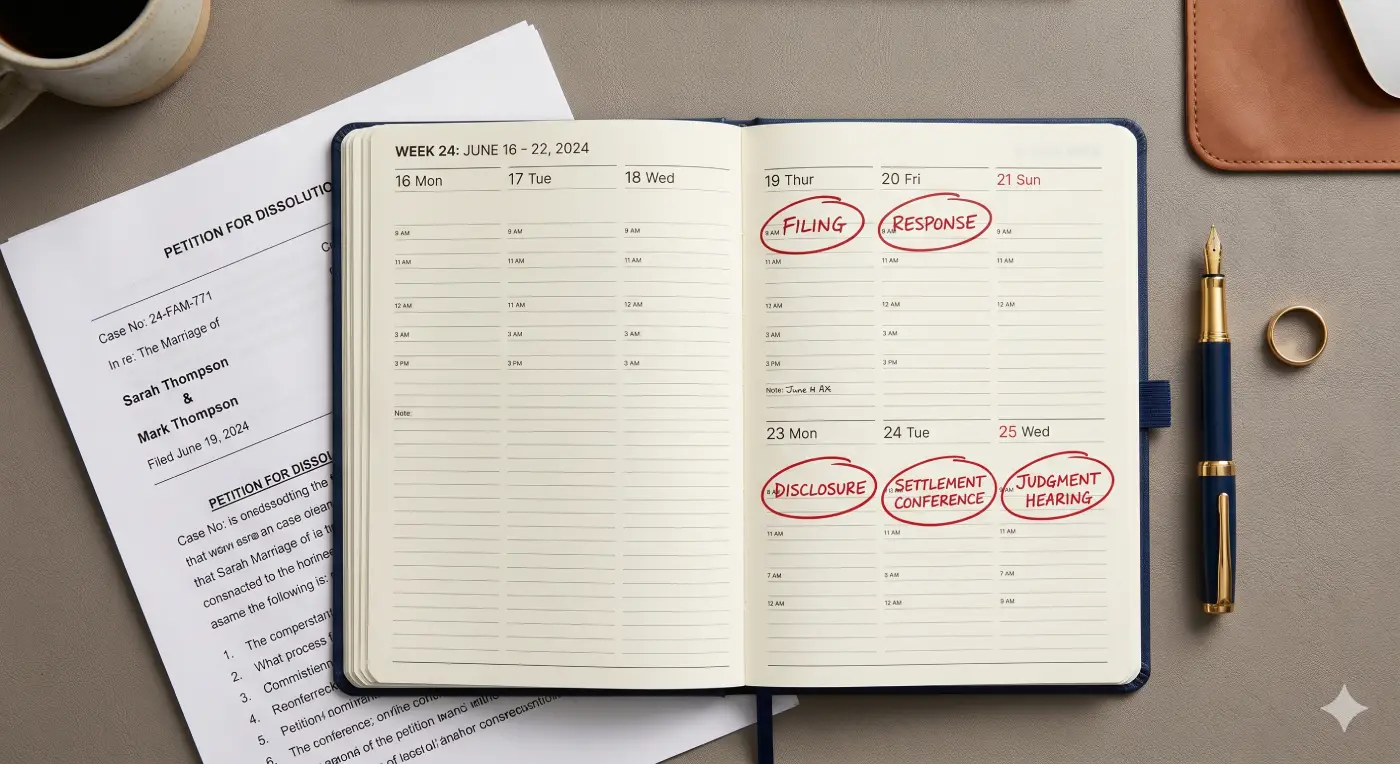
After more than 50 years guiding Southern California families through dissolution, our office has seen straightforward cases wrap up in just over six months and complex litigated matters stretch beyond two years. This guide breaks down each stage so you can plan your finances, your living situation, and your peace of mind with realistic expectations.
The 6-Month Mandatory Waiting Period
California Family Code §2339 requires a minimum of six months and one day between the date your spouse is served with the petition and the date your marital status can be terminated. There is no way to shorten this period. Even if both spouses agree on every issue and submit a complete settlement on day one, the court will not finalize the divorce until that clock runs out.
Stage 1: Filing the Petition (Week 1)
Your divorce officially begins when the Petition for Dissolution (Form FL-100) and Summons (Form FL-110) are filed with the Los Angeles Superior Court. The filing fee is currently $435, with fee waivers available for low-income petitioners. You then have 60 days to formally serve your spouse.
Stage 2: Response Period (Weeks 1–4)
Once served, the responding spouse has 30 days to file a Response (Form FL-120). If they fail to respond, you may proceed by default. If they respond, the case becomes contested in name even if you ultimately settle every issue out of court.
Stage 3: Temporary Orders & Preliminary Disclosures (Months 2–4)
This is where most timelines either stay on track or begin to stretch. Either spouse may file a Request for Order to obtain temporary orders for child custody, child support, spousal support, or use of the family residence. Both parties must also exchange Preliminary Declarations of Disclosure (Forms FL-140, FL-141, FL-142, and FL-150) within 60 days of filing the petition or response.
Stage 4: Discovery & Negotiation (Months 4–8)
Discovery is the formal exchange of financial documents, account records, business valuations, and answers to written questions. In contested cases, this stage often involves depositions, subpoenas to third parties, and expert witnesses such as forensic accountants or custody evaluators. Many couples settle during this stage once they have a clear picture of the marital estate.
Stage 5: Mediation or Trial (Months 6–18+)
Roughly 90 percent of California divorces settle through mediation, four-way meetings, or judicial settlement conferences. The remaining cases proceed to trial. A typical contested trial in Los Angeles County is set 12 to 18 months after filing, sometimes longer for high-conflict or high-asset matters.
Stage 6: Judgment of Dissolution
Once the parties sign a Marital Settlement Agreement, or the judge issues a ruling after trial, the attorneys prepare the Judgment of Dissolution. After the judge signs and the court enters the judgment, you receive a Notice of Entry of Judgment in the mail and your marital status is officially terminated.
What Makes a Divorce Take Longer?
- Disputes over child custody or parenting time
- Complex assets such as businesses, restricted stock, or out-of-state real estate
- Allegations of hidden income or undisclosed accounts
- Domestic violence allegations requiring protective orders
- A spouse who refuses to participate in disclosure or settlement
What Speeds a Divorce Up?
- Choosing mediation or collaborative divorce from the start
- Completing financial disclosures fully and on the first request
- Working with a family law attorney who has Los Angeles courtroom experience
- Reasonable expectations and willingness to compromise on non-essential issues
Frequently Asked Questions
Q: Can I get a divorce faster than six months in California?
A: No. The six-month waiting period is statutory and cannot be waived. However, you can finalize all other issues—custody, support, and property division—before the six months expires. Only the marital status itself must wait.
Q: What is the fastest realistic divorce in Los Angeles?
A: A truly uncontested divorce with a complete settlement, full disclosure exchange, and cooperative parties can finalize at roughly 6 months and 2 weeks from the date of service.
Q: Do both spouses need to live in California?
A: Only one spouse needs to be a California resident for at least 6 months and a resident of the filing county for at least 3 months before filing.
Suggested internal links:
- Link to: How a Divorce Lawyer Prepares You for Mediation Success
- Link to: What Drives Divorce Legal Fees Higher? Avoid Costly Traps
- Link to: Common Questions page (Areas of Practice → Dissolution)
📞 Considering divorce in Los Angeles? Call Hermes Law Group at (213) 368-0000 for a confidential consultation with an attorney who has guided Southern California families through dissolution for over five decades.